


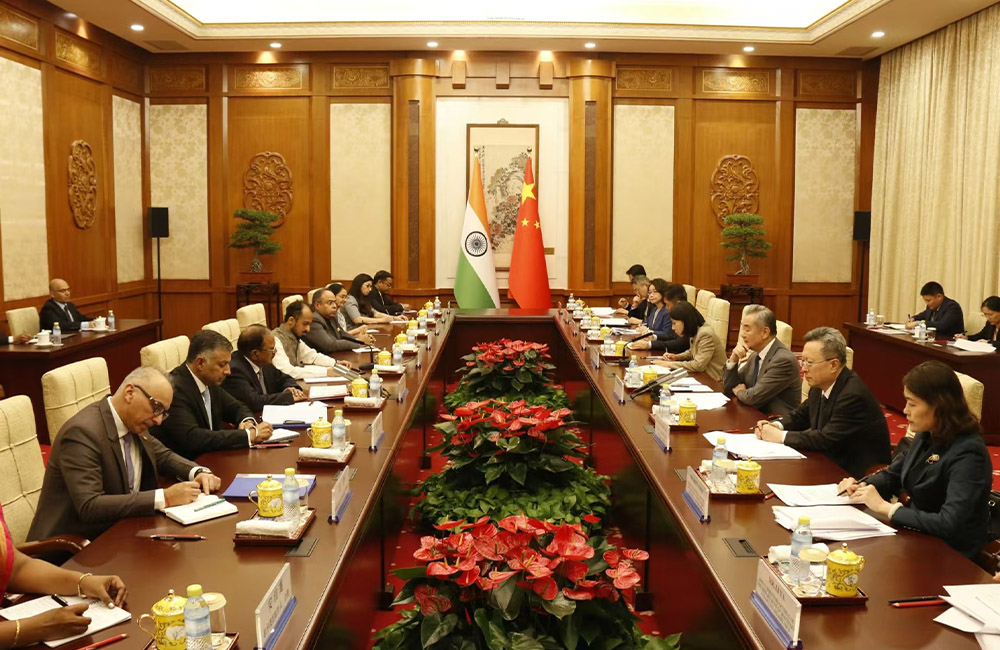
(TibetanReview.net, Aug25’26) – India’s National Security Adviser Ajit Doval and Chinese Foreign Minister Wang Yi have on Aug 25 held the 25th round of Special Representatives’ talks on the India-Tibet boundary question in Beijing ahead of an expected visit to India next month by President Xi Jinping for the BRICS Summit.
The talks focused on the boundary question, bilateral relations and regional and international developments, as New Delhi and Beijing seek to consolidate a cautious stabilisation in ties following the prolonged military stand-off in eastern Ladakh triggered by the 2020 Galwan Valley clash, said indiatoday.in Aug 25.
The report said the meeting assumed added significance as it took place ahead of the BRICS summit in New Delhi on Sep 12 and 13, which is expected to see participation by Chinese President Xi Jinping, although Beijing has not officially confirmed his visit yet. The visit, should it take place, will be Xi’s first in seven years.
A potential meeting between Prime Minister Narendra Modi and Xi on the sidelines of the summit could provide political momentum to efforts to improve bilateral relations. The two last met in Aug 2025 on the sidelines of the Shanghai Cooperation Organisation summit in Tianjin, the report said.
The two sides have plenty of issues, including weighty ones, to discuss on their differences as well as scopes for cooperation.
To India, one of the most important issues is the situation along its border with Chinese occupied Tibet on which there has been no progress at all on a settlement. Discussions still continue to be focused on maintaining the peace even as the two sides continue to sustain their build-up and remain battle-ready at all times.
India has repeatedly maintained that peace and tranquillity along the border are fundamental to the wider relationship. Speaking at the Economic Times World Leaders Forum in New Delhi on Aug 22, External Affairs Minister S Jaishankar reiterated that peace and tranquillity in the border areas were a prerequisite for stable relations between the two countries, the report said.
It also cited India’s Ministry of External Affairs (MEA) as describing developments along the border as a matter of the “most serious” concern. Its spokesperson, Randhir Jaiswal, also said recently that maintaining peace and tranquillity along the LAC was of “utmost importance”, stressing that the situation on the frontier would determine the overall trajectory of India-China relations.
China, however, continues to give less importance to the border issue, and more on other areas of bilateral ties between the two sides, including especially trade and investment on which it already enjoys huge and growing advantages. The trade balance has continued to balloon in China’s favour despite India’s constant efforts, year after year, to get Beijing to address the increasingly unsustainable imbalance by opening up its markets to Indian products and services.
On the border issue, while the disengagement process in eastern Ladakh has helped ease some of the immediate military tensions along the Line of Actual Control (LAC), the broader boundary dispute remains unresolved. Arunachal Pradesh continues to be one of the most sensitive components of the dispute, the report noted.
China has enhanced its claims on the entire Indian state of Arunachal Pradesh, which it has taken to refer to as “Zangnan”, or southern Tibet, in recent years. India has consistently rejected the claim, maintaining that the state is an integral and inalienable part of itself.
The India-Tibet boundary extends approximately 3,488 km and remains disputed across three broad sectors, with significant differences between the two sides over their respective perceptions of the LAC.
While a final settlement still remains a far cry, the two sides have worked out a structured channel for senior-level political communication, particularly during periods when tensions along the frontier have threatened to spill over into the wider relationship.
Ahead of the Doval-Wang meeting, Chinese Foreign Ministry spokesperson Lin Jian described the Special Representatives talks as the “main channel” for negotiations between China and India on the boundary question and an important platform for communication on issues of mutual interest.
The Aug 25 talks mark the latest high-level diplomatic engagement as both sides seek to maintain that current stabilisation while differences over the boundary remain unresolved, the report said.
The Doval-Wang talks could help provide a diplomatic backdrop for high-level engagement between Modi and Xi by addressing sensitive areas of disagreement and reinforcing existing understandings on maintaining peace along the LAC, the report added.