


Elia Mantovan* says he founded Nomads Tibet, which serves Tibetan momos at festivals, cultural events and public gatherings throughout Italy, as a way to open Tibet and its culture, with which he grew up since childhood, to the outside world, with plans to develop it further as a travelling cultural project.
There are stories that begin with a business idea. Others begin much earlier, in childhood, almost without us realizing it.
The story of Nomads Tibet began in Italy, but its roots go back to the Tibetan community, to the Buddhist world of Pomaia, and to the people I grew up around.
I was born and raised in Pomaia, in Tuscany, at the Istituto Lama Tzong Khapa, one of the places where Tibetan Buddhism established an important presence in Italy. For me, the Institute was not simply a place I visited or attended occasionally. It was the environment in which I grew up.
As a child, Tibetan culture was therefore not something distant or exotic. It was part of everyday life. I grew up surrounded by Tibetan monks, Western practitioners, teachers and visitors from different parts of the world. I had the opportunity to encounter Tibetan masters who came to the Institute and to see, from an early age, how a culture could travel across continents while maintaining a strong sense of identity.
My mother later became a Buddhist nun, and Buddhism became an even deeper part of our family life. From an early age I also had the opportunity to travel to India with her and to continue encountering the Tibetan community there. Over the years, I returned to India and to Dharamsala and McLeod Ganj, where the connection with the Tibetan world became something personal rather than simply cultural.
I have followed the teachings of His Holiness the Dalai Lama since childhood, and these experiences have accompanied me throughout my life.
But there was another part of Tibetan culture that stayed with me in a much more everyday and tangible way: food.
Learning through food
I learned to make momo as a child, in an environment where Tibetan monks and members of the community were cooking and sharing food together.
Momos are Tibetan steamed dumplings, traditionally prepared for families, communities and celebrations. They are simple in appearance, but they carry something much larger than their ingredients. Food can preserve memory. It can cross borders. It can create a meeting point between people who otherwise might have little in common.
For me, making momo was never simply about learning a recipe.
It was about learning something through people.
The flavors, gestures and ways of preparing food became part of my memories of the Tibetan community. Years later, when I began thinking about creating Nomads Tibet, I realized that this was one of the most authentic ways in which I could share a part of the culture that had accompanied me since childhood.
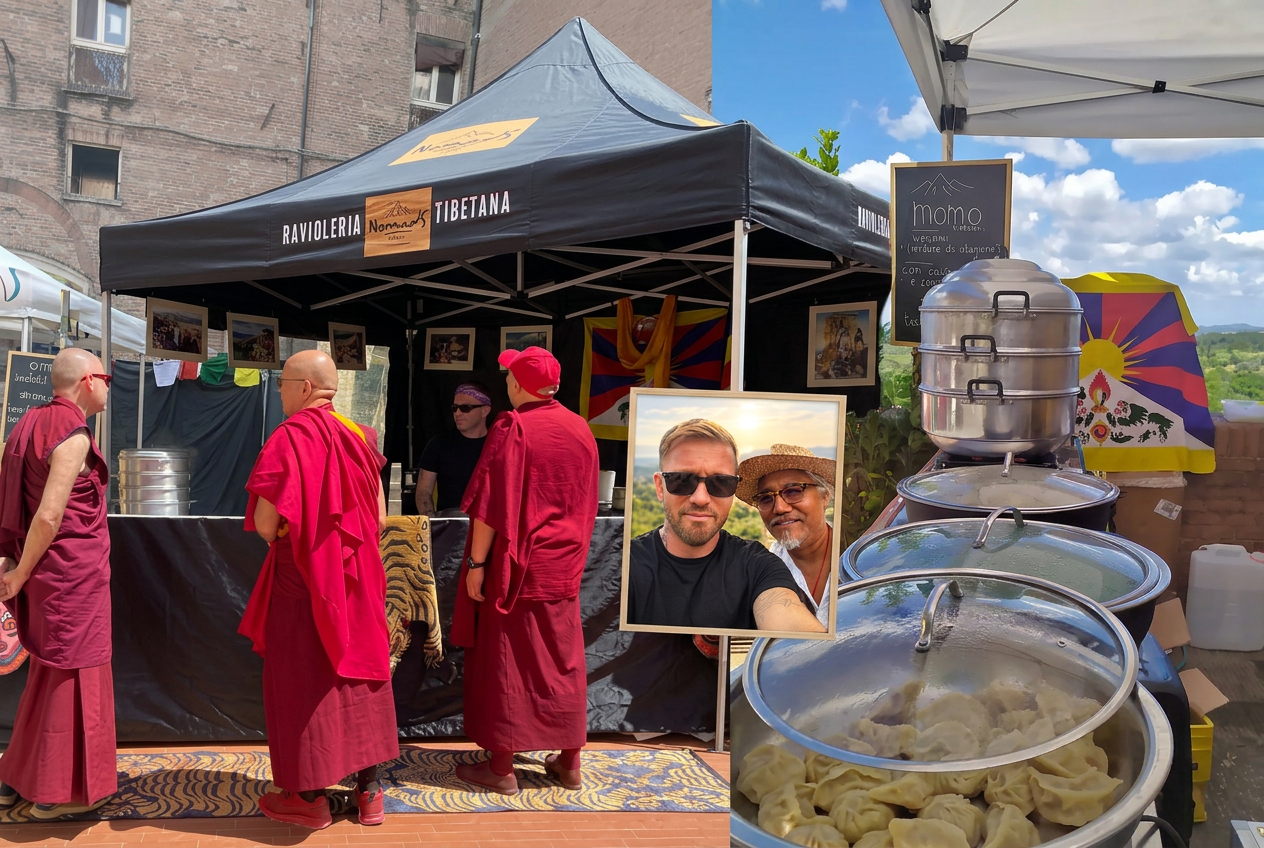
Jinpa and the first Tibetan community in Italy
An important person in this story is Jinpa, who today works with me at Nomads Tibet.
Jinpa was one of the founders of the Tibetan community in Italy. His generation represents an important chapter in the history of Tibetans who left Tibet and established new lives in other countries.
Working together today creates a direct connection between two different moments in this story: the generation that had to leave Tibet and rebuild a community far from home, and a younger generation that grew up in Italy while remaining connected to Tibetan culture.
This connection is important to me.
Nomads Tibet is not an attempt to reproduce Tibet artificially in Italy. It is an attempt to show how culture can continue to live, change and find new forms without losing its roots.
Why “Nomads”?
The name Nomads Tibet comes from the Tibetan nomadic tradition.
The Tibetan nomads, or drokpas, traditionally lived across the high plateaus of Tibet, moving with their animals and adapting their lives to an enormous and often demanding landscape.
For us, the idea of the nomad is also a metaphor.
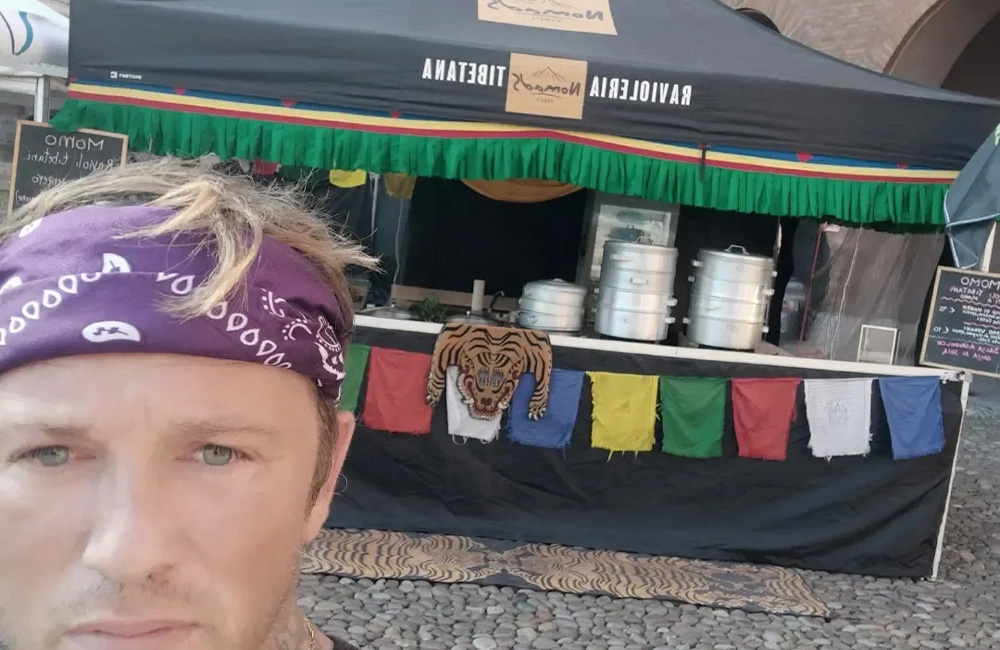
Nomads Tibet travels. We bring Tibetan food and elements of Tibetan culture to Italian cities, festivals and events. Instead of asking people to come to Tibet to encounter something unfamiliar, we take a small piece of that world with us.
Our black tent-like structure is inspired visually by the traditional black tents of Tibetan nomads, traditionally made from yak hair. Our gazebo is, of course, a modern structure and is not made from yak hair, but its dark appearance is a deliberate reference to that tradition.
Inside it, the atmosphere is deliberately different from a conventional food stand.
We want people to feel that they have entered a small travelling cultural space.
More than food
When Nomads Tibet began taking shape, I did not want it to become simply another street-food business.
The food is the doorway, but it is not the whole story.
A plate of momos can be the beginning of a conversation.
Someone may come because they are curious about Tibetan dumplings. They may leave having learned something about Tibet, Tibetan Buddhism, the nomadic traditions of the plateau, or the history of the Tibetan community in Italy.
This is why, alongside food, we are interested in sharing stories, images, objects and encounters.
At our events, Tibetan music, traditional objects, photographs and conversations can become part of the experience. We are also interested in creating opportunities for people to meet Tibetans and hear their experiences directly.
In the future, I would like Nomads Tibet to develop even further as a travelling cultural project: a space where food, history, contemporary Tibetan life and personal stories can meet.
From Pomaia to Italian festivals
The first time Nomads Tibet began appearing at Italian events, I realized how powerful this combination could be.
People who had never encountered Tibetan food before were suddenly standing in front of a steamer filled with momos.
Some knew Tibet very well. Others knew almost nothing about it.
There were Buddhist practitioners, travelers, families, young people and people who had simply stopped because they were attracted by something unfamiliar.
The reaction was often the same: curiosity.
And curiosity is a very good place to begin a cultural exchange.
This is particularly meaningful to me because I grew up in Pomaia, in a place where cultural exchange was part of everyday life. Today I find myself bringing a small part of that experience into completely different environments.
A Tibetan food stand at an Italian festival may seem like a very small thing. But sometimes culture travels through precisely these small things.
A culture that continues to travel
The Tibetan diaspora has created communities in many parts of the world. Their history is often discussed through politics, exile and the preservation of identity.
Those subjects are essential.
But culture is also preserved through everyday life: through language, food, family memories, music, craftsmanship, religious traditions and the relationships between generations.
This is where I see the meaning of Nomads Tibet.
I am not Tibetan by birth. My connection with Tibet comes from a lifetime spent within and alongside the Tibetan Buddhist community, beginning in childhood in Pomaia and continuing through my encounters with Tibetans in Italy and in India.
I do not want to present myself as someone who can speak on behalf of Tibetans.
Instead, I want to share the part of the story that belongs to me: the story of someone who grew up close to this culture and who found, through food and travel, a way to keep that connection alive.
Working with people such as Jinpa makes this connection even more meaningful. His generation and mine have lived very different experiences, yet we can work together on something that looks toward the future.
From one table to another
At the heart of Nomads Tibet there is a simple idea.
People meet around food.
A momo is small. It can fit in the palm of a hand. But around a plate of momo, people begin to ask questions.
Where does this food come from?
What is Tibet like?
Who are the people who make it?
What happened to the Tibetan community in Italy?
What does it mean to preserve a culture far from its homeland?
These conversations are what interest me most.
Nomads Tibet is therefore not only about bringing Tibetan food to Italy. It is about allowing something that travelled from Tibet to Italy many years ago to continue travelling.
From the Tibetan plateau to India.
From India to Pomaia.
From Pomaia to Italian cities.
And now, through Nomads Tibet, from one festival and one table to another.
The journey continues.
—
* Elia Mantovan, founder, Nomads Tibet, can be visited at @nomadstibet on Instagram