



Saurabh Chauhan* dwells on a collection of conversational poems on the highly popular Tibetan Buddhist deity Tara by Soumya Sambasivan, an Indian Police Service (IPS) officer who serves as Deputy Inspector General of Police for the Northern Range in Himachal Pradesh, which asks what it means to seek help, to let go of the self and to find a place for compassion in a world that can often seem governed by judgment and conflict, and which tries to answer the question how does one remain engaged with the world without being entirely consumed by it.
DHARAMSHALA: The café in Dharamshala had an unusual setting for a discussion on poetry. Its terracotta-red walls were covered with dozens of New Yorker magazine covers, hung from wires. Below them stood a wooden cabinet with iron-mesh doors, a golden statue of Tara, a flute and a Dranyen, a traditional Tibetan stringed instrument. A microphone had been placed nearby.
Outside, the Dhauladhar range had received fresh snowfall. Inside, locals, travellers from different parts of India and foreign visitors had gathered for a conversation about poetry, faith and the place of the divine in everyday life.
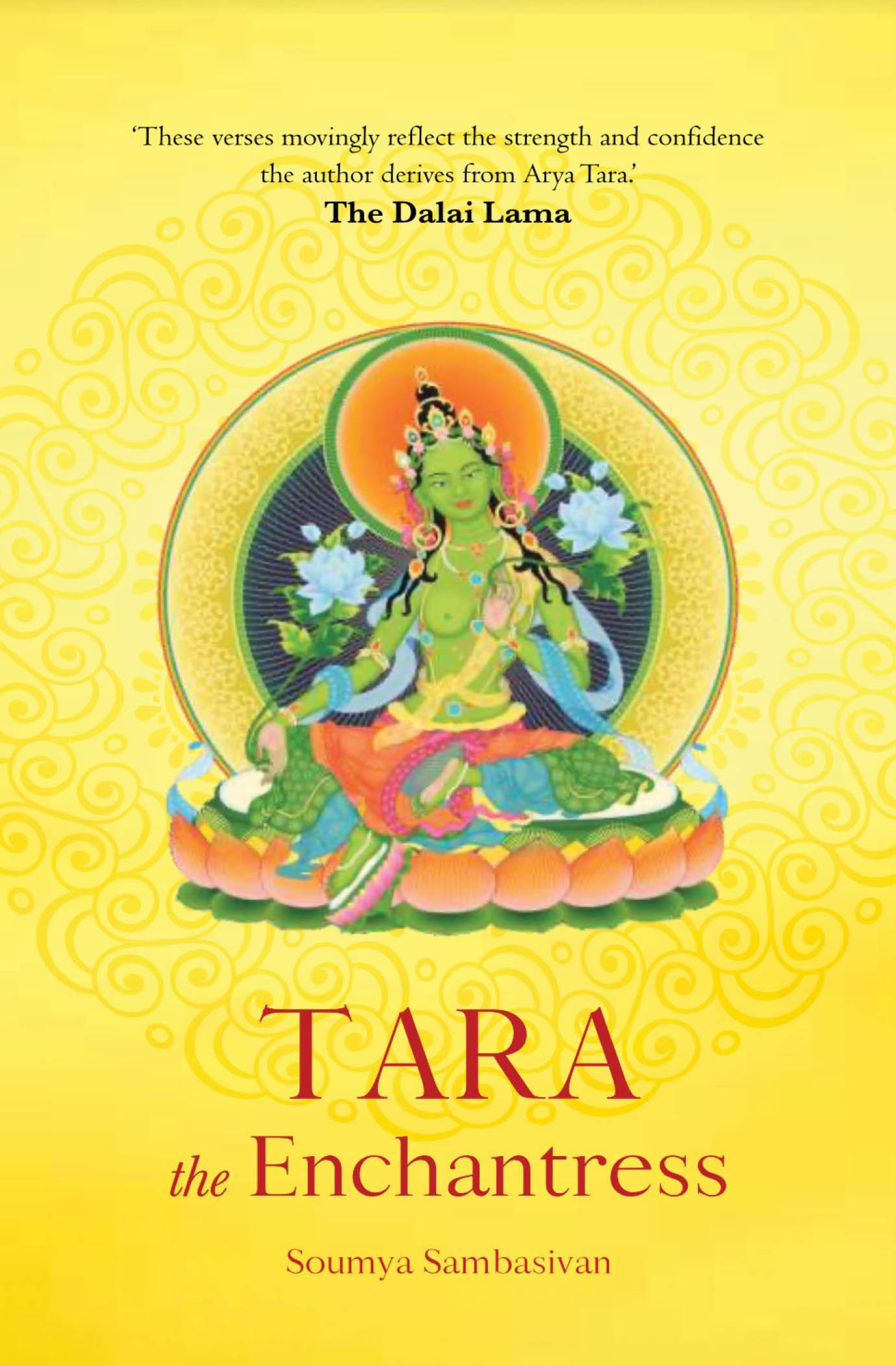
The discussion centred on Tara the Enchantress, a collection of poems by Soumya Sambasivan, an Indian Police Service (IPS) officer who serves as Deputy Inspector General of Police for the Northern Range in Himachal Pradesh. She was in conversation with Tibetan poet and writer Bhuchung D. Sonam.
As Sonam put questions to her, Sambasivan spoke about Tara, devotion and the idea that spiritual life need not be separate from one’s daily responsibilities. For someone who works within the police force, where decisions can have serious consequences for people’s lives, this was an interesting meeting of two seemingly different worlds.
She also spoke about Advaita, the philosophy associated with Adi Shankaracharya, which holds that the individual self and the ultimate reality are not separate. These ideas run through her poems, though the book is less concerned with explaining philosophy than with expressing a personal relationship with the divine.
Tara the Enchantress is not a conventional collection of devotional hymns. The poems read more like conversations with Tara. The speaker approaches her as a mother, someone who can be addressed directly, questioned, and asked for help. There is little distance between the devotee and the deity. Tara is not confined to a temple or a religious image; she is someone the speaker wants beside her in moments of uncertainty and distress.
The Dalai Lama, in his foreword, writes that the verses “movingly reflect the strength and confidence the author derives from Arya Tara.” The Twelfth Tai Situ Rinpoche describes the collection as born out of devotion to Tara’s wisdom and compassion, bringing together relative and ultimate truth.
Tara occupies an important place in Tibetan Buddhism, where she is associated with the compassionate activity of the Buddhas. Green Tara, often depicted with one foot extended, is understood as ready to respond to those who need her help. In Indian traditions, Tara also appears among the Mahavidyas, the ten great wisdom goddesses. Her forms and associations vary across traditions, but compassion, protection, and the power to help beings cross difficult passages are recurring themes.
Sambasivan draws on these religious traditions without turning the poems into explanations of doctrine. Her Tara is a living presence, and the language is personal, sometimes pleading and sometimes demanding.
The opening poem, “From Nothing to Eternity,” begins with the speaker offering a small lamp to the rising sun and a single pink rose among countless flowers. The request is modest: a little mercy. There is a sense of the devotee standing before something immeasurably greater, unsure of what she can offer but hoping that the offering will be accepted.
The poem “Today is the Day of Judgment” takes a different approach. Here, the speaker finds herself in a courtroom where the book of karma is examined and arguments continue without end. Tara steps down from her throne and takes the trembling figure into her arms. The courtroom, usually associated with judgment and the consequences of one’s actions, becomes a place where compassion offers another kind of relief.
The poem is especially interesting in the context of Sambasivan’s profession. The law deals with evidence, responsibility, and judgment. The poem does not offer a simple comparison between divine and human justice, but it imagines what it means to be held and understood at a moment when one feels entirely exposed.
In “Mind – The Wild Beast,” the mind is presented as a creature more difficult to control than the lions and serpents Tara has tamed. The speaker asks for the courage to stand up for the weak and abandoned and to flower like a desert plant without waiting for rain. Here, devotion moves beyond personal comfort. It becomes a request for the strength to act.
“Emptiness” approaches the relationship between devotee and deity from another direction. The speaker offers an open palm, with nothing left to give, and declares, “Mother! You are my universe, and I think of no other.” Emptiness is not presented simply as absence. It becomes a space in which the devotee can surrender her sense of separateness.
One of the more striking poems is “Please Get Off the Lotus.” The speaker asks Tara to leave her elevated seat and put her feet on the ground, amidst the difficulties of ordinary life. Even the image of Tara’s anklets breaking and scattering beads of refuge suggests that the divine should not remain inaccessible. Help should reach people where they are.
A similar idea appears in “Here She Stands in Front of You.” The familiar objects of religious practice, including the rosary, vajra, bell, lamps, and incense, become less important than the presence of Tara herself. The poem asks the reader to look beyond the formalities of worship and recognise what may already be present.
In “Break Me Open Like an Idol,” the speaker asks Tara not merely to comfort her but to break down the self completely. She imagines melting like an ice doll in the Mother’s hand and flowing out as a river that can heal the landscape before returning as rain.
The poem ends with a striking refusal: “If this is the deal, then I do not wish to seek Nirvana!”
It is an unusual statement in a devotional collection. Rather than seeking liberation as a personal achievement, the speaker seems willing to give up that goal in order to become useful to others. The desire is to be part of the healing, not simply to escape suffering.
The more forceful side of Tara appears in “Destroy This Illusion,” where she is called upon to destroy the structures of hatred, violence, and war. The imagery is fierce, with weapons, fire, and thunderbolts replacing the gentler language of refuge found elsewhere in the book. Tara is not only a mother who consoles. She is also a force that confronts what causes suffering.
Other poems are quieter. “Oh! There is Everything in Thy Name” finds strength, solace, order, and chaos within Tara’s name. In “Enchantress,” she is associated with Time itself, the companion present from birth until death. “In My Longing to Meet You” returns to the question of how many lives and how much suffering separate the devotee from the desired union with the divine.
These poems differ in tone, but the central concern remains much the same: how does a person move beyond the limits of the self, and what does that mean for the way one lives?
The conversational style helps the collection in this regard. Tara is addressed as someone familiar, almost as one might speak to a mother in a difficult moment. The approach makes the poems accessible even when they deal with ideas such as karma, emptiness, and liberation. At times, the language is emphatic, and the devotion is absolute. Readers looking for restraint may find some of the declarations excessive, but the intensity is part of the book’s character.
Sambasivan’s work as a police officer adds another dimension to the collection. Her professional life involves rules, decisions, and the exercise of authority. The poems, by contrast, repeatedly return to surrender, compassion, and the limits of individual control. Yet the two need not be opposites. The book suggests that inner renunciation does not necessarily mean withdrawing from the world. A person can continue to work, meet responsibilities, and deal with everyday problems while questioning the importance of the ego and personal ambition.
This is where the connection with Advaita becomes relevant. The idea that the individual self is not separate from ultimate reality finds a place in the speaker’s longing to dissolve into Tara. The collection does not set out to prove this philosophically. Instead, it approaches the idea through prayer and repeated appeals to the divine.
The book also brings together elements from Indian and Tibetan religious traditions. Tara has a place in both, though her forms and interpretations are not identical. Sambasivan’s poems approach her through personal devotion rather than a detailed examination of those differences. The result is a collection that is more concerned with an individual’s relationship with the divine than with establishing theological boundaries.
The setting of the discussion added to the occasion. Dharamshala has long been associated with the Tibetan community in exile and with the presence of the Dalai Lama. Conversations about Buddhism, identity and spiritual practice are part of the town’s cultural life. With Bhuchung D. Sonam, whose writing is closely connected to Tibetan experience and exile, asking the questions, the discussion had a context beyond the book itself.
Still, Sambasivan’s central concern remained personal. She did not present the poems as instructions or claim that they offered a way to resolve every difficulty. They record a continuing conversation with Tara, one that moves between doubt, longing, surrender and faith.
At 67 pages and measuring five by eight inches, Tara the Enchantress is a small book. Its concerns, however, are not small. It asks what it means to seek help, to let go of the self and to find a place for compassion in a world that can often seem governed by judgment and conflict.
Back in the café, the red walls, the hanging magazine covers and the golden statue of Tara formed the backdrop to the discussion. The evening brought together poetry, religious thought and the everyday life of a hill town shaped by many cultures.
For Sambasivan, the conversations with Tara continue on the page. Whether read as devotional poetry or as a personal exploration of faith, the collection returns to a simple but difficult question: how does one remain engaged with the world without being entirely consumed by it?
—
* Saurabh Chauhan is a journalist and independent researcher based in Himachal Pradesh. He spent nearly eight years with Hindustan Times, reporting from Shimla, Chandigarh and Lucknow, where he covered a wide range of political, social and environmental issues. His work has also appeared in platforms such as The Print, BBC Hindi, Firstpost and several other publications. Currently working independently, Chauhan is engaged in long-form research and writing. He is authoring a forthcoming book, Prayer Wheels in the Cloud, which explores the future of Tibetan culture, religion and political struggle through the lens of technology and a rapidly changing world.