


(TibetanReview.net, Sep04’26) – Referring to the devastating glacier-avalanche triggered Tibet-Nepal flash floods of Aug 26 morning that wiped out villages and markets while claiming what may amount to several thousand lives, China said Sep 2 that such disasters may become more frequent as a result of global warming. Many will argue that China’s infrastructure, mining, and resettlement devastation of the Himalayan environment plays big role in this worsening situation.
Glacier disasters could become more frequent as global warming further weakens glacier stability on the Tibetan Plateau (now being referred to by China as “Qinghai-Xizang” Plateau after previously calling it “Qinghai-Tibet” Plateau), potentially triggering cascading effects that amplify damage and widen their impact, reported China’s Party mouthpiece globaltimes.cn Sep 2, citing an announcement that day by the country’s National Climate Centre.
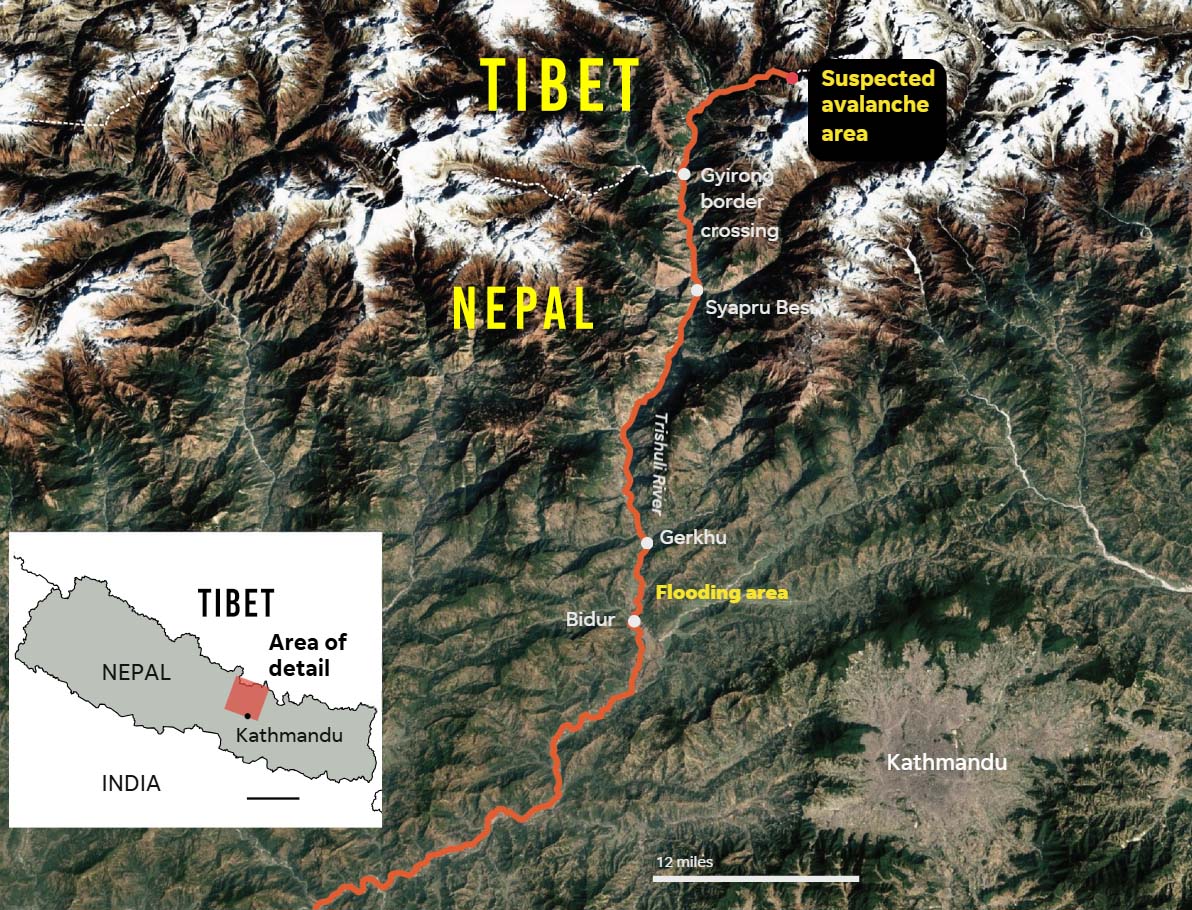
After analyzing remote-sensing monitoring data and information transmitted from the Tibet-Nepal disaster site, and combining these findings with on-site inspections and field visits, the cryosphere emergency response and disaster mitigation team of the Institute of Mountain Hazards and Environment, Chinese Academy of Sciences, concluded that at around 10:52 am on Aug 26, a glacier on the northern slope of Mount Langtang Lirung in Nepal broke off at an elevation of approximately 5,200 metres, triggering an ice-and-rock avalanche, the report said.
After explaining how the Aug 26 disaster played out, giving no room for immediate counteraction, the report cited Gao Rong, deputy director of China’s National Climate Centre, as saying during a press conference held by the China Meteorological Administration on Sep 2 that global warming is accelerating the melting of mountain glaciers worldwide.
Climate warming has altered the dynamic characteristics of glaciers, leading to rising ice temperatures, faster glacier flow and more frequent surges. Since the beginning of the 21st century, particularly since 2010, ice avalanche events in high-altitude mountainous regions around the world have been on the rise. Against the backdrop of a warmer and wetter climate on the Tibetan Plateau, glaciers across the region are generally undergoing accelerated melting, Gao has said.
Citing the Glacier Inventory of what constitutes the People’s Republic of China, Gao has said that glacier coverage on the Tibetan Plateau has shrunk by about 24 percent over the past 60 years, with some 7,000 small glaciers disappearing entirely.
Rapid warming on the Tibetan Plateau is driving accelerated melting of the cryosphere, leading to an increase in the number of glacial lakes and rapid expansion of their area, while glaciers are becoming dynamically unstable, Gao has added. The cryosphere is the frozen water part of the Earth system, covering all regions where water exists in solid form like ice, snow, and permafrost.
It is expected that the internal structural stability of glaciers on the Tibetan Plateau will decline further in the future. Glacier-related disasters may become more frequent and could also trigger cascading disaster effects, amplifying the scale of destruction and expanding their impact, Gao has said.
* * *
Meanwhile, in Nepal, confirmed deaths from the Aug 26 morning flash floods has risen to 1,287 as of Sep 4 at 12:30pm, with the number of missing persons climbing to 5,083, reported the kathmandupost.com Sep 4, citing the National Disaster Risk Reduction and Management Authority, under the Ministry of Home Affairs.
The report said the toll included 140 bodies recovered in Rasuwa, 184 in Nuwakot, 63 in Dhading, 72 in Gorkha, 38 in Tanahun, 219 in Nawalparasi East, 212 in Nawalparasi West and 359 in Chitwan. Most of the missing are from Rasuwa (2,130) and Nuwakot (2,340). The official tally also lists 583 foreign nationals as missing.
On the Tibetan side of the border, in Kyirong, the number of deaths has risen to 31 as of today at 6pm, with 531 still listed as missing, as reported by China’s official Xinhua news agency Sep 4.