


6 Levels of Remedial Measures
OPINION

Following Tenzin Norsang’s article titled “The Stick Must Stop: Ending Corporal Punishment in Our Tibetan Schools” (tibetanreview.net, Apr 11, 2026), Tenzing Rapgyal* explains how he has effectively dealt with errant students in a situation where corporal punishment is banned, concluding it, however, with a reality check.
The class of 2023 in real life in the peaceful foothills of the Himalayas was not like The Class of 1999 in reel -life in the violent world of Hollywood cinema. But the students of 12th standard in 2023 became notorious for being the most difficult batch to deal with. Was the evidence of perception empirical in nature?
The atmosphere within the school that year was filled with negativity caused by an unprecedented series of unfortunate incidents that led to the perception:
- An acrimonious altercation between some senior most students and the members of advisory committee members while taking round the hostel during evening self-study hour.
- The public display of conflict between a teacher and a student during morning assembly.
- A case of theft in the school tuck shop by middle school students.
- A viral case of some 10thstudents caught on camera in an inebriated condition in their hostel.
- An account of a student with a violent past running after the foster mother in the hostel.
What are the Causes of In-disciplinary Problems?
In addition, the growing challenge for teachers to manage class is pressing due to the ban on corporal punishment in our school in early 2000s as a result of which these days, positively, children are free from the fear of the punishments of our time in 1900s: spanking, thrashing, kneeling on the floor, being ‘murga’, shunning out of class, public shaming in the assembly and other inventive and coercive methods of crushing the individuality of the problematic students. Moreover, making your lessons interesting every day to engage students is not as easy as they try to sell in workshops given the limited knowledge of IT among teachers and the race to finish the prescribed syllabus to prepare students for the system of exam which earmarks only 20% of weightage for 10 months of internal assessment and generously grants 80% of marks for the annual exam of three hours. Therefore, for most students, passing the final exam has become much easier because of the prescribed marking schemes which seem to be designed to pass the students so that they don’t drop out of school due to failure and studying intensively burning ‘midnight moonlight’ for a month or two before the exam. So, students, unless pushed by parents at home, have neither the intrinsic nor the extrinsic motivation to study causing disciplinary problems in the class and hostels. Trying to change this systemic failure is like hitting your head on the wall. That does not mean that one should give up and surrender to the reality, but by being wise and realistic, one can deal with the situation, which I have been trying to do so after being a prey to the dreaded hopelessness.
What are the Types of Disciplinary Problems in my Class?
The common disciplinary hindrances put up by the students which I have tried to overcome for effective teaching are bunking, being late after break, sleeping even during the first period, irregular in class work, incompletion of home assignment and being inattentive by chatting or not having the textbook or being disruptive in the class. Another category I have added to the list is misbehavior which I did not encounter any. The lapse which irritates me most is being late in the class because it disrupts the flow of the lesson. To deal with this nuisance I used humor too. For example, when students knock on the door being late while the lesson is going on, I would stop teaching and let them enter with a thunderous applause of the audience in the class befitting a much awaited dignitaries. But, students who were punctual were losing their precious time. Therefore, I made a rule that if they are late and find the door ajar they should enter silently without asking for the cursory permission and sit at their desk opening their book without making any noise. If the door is bolted from inside, which means they are considered absent as they have been late for more than 20 minutes of the period.
What are the Remedial Measures I have taken?
For the last five years my remedial measures have evolved into a system of 6 Levels of Remedial Measure. Earlier my remedial steps were reactive because I did not have a system to deal with the repeated lapses by some students. There was no clarity on the consequences for their breach. As a result of which out of frustration on both parties specifically the teacher, verbal confrontation would happen sometimes, which impacts the whole class with the loss of productive environment. So, to avoid unnecessary altercation with the problematic students and to set a clear boundary and the ramification for the breach by the erring pupils, I have applied the following system with a satisfactory result:
| Level | Remedial Measures |
| 1 | I. 3 chances to improve II. If a student does not show any improvement even after the 3rd chance, the last warning will be given with one on one conference with the student. III. In the case of being absent, he/she will be reported to the headmaster’s office every time they are absent and are detained during break/after class/weekends to do manual work. |
| 2 | I. If a student who has been through Level 1 continues to fail in improving himself/herself, he/she will go through the 1st and 2nd steps of Level 1 except in the case of being absent in the class. II. If a student still continues not to show any improvement even after the warning and the conference, he/she will be detained to do community service on holidays. |
| 3 | I. If a student still continues to fail in improving himself/herself, he/she will be referred to the headmaster’s office for further remedial actions |
| 4 | I. If a student still continues to fail in improving himself/herself, he/she will be referred to the headmaster’s office to arrange a meeting for the concerned teacher (i.e., me) with their parents/guardians/warden/matron for further remedial actions. |
| 5 | I. If a student still continues to fail in improving himself/herself, he/she will be referred to the principal’s office for further remedial actions |
| 6. | I. If a student still continues to fail in improving himself/herself, he/she will be referred to the headmaster’s office to arrange an urgent meeting of all the concerned stakeholders, i.e., principal, headmistress, the teacher and the student’s parent/guardian/warden/matron for further remedial actions. |
How Effective have the Remedial Measures been?
To answer the question, let me present a quantified response. Since the beginning of the session in March, 2023 to the end of January, 2024, I had been keeping the record of the students’ different types of lapses which numbers to 1049 registered cases from 13th June, 2023 to 24th January 2024, the last day of the extra coaching class for class XII students preparing for the board exam. From 3rd March to 12th June, I did not keep the daily record in my class management note book. I systematically, methodically and laboriously started to register the cases every day from 13th June because of some students asking me the written evidence of their lapses when I call them for one to one conference after crossing the first level of remedial measure. The first record of students crossing the second level to the third level is dated 18th April, 2023. Thanks to their exercising the right to information they might have learned in their Political Science class that I have 64 pages of my notebook recorded with their diversity of deviations!
After tabulating the number of cases under the different types of lapses, viz., being late/absent, sleeping, inattentiveness (talking, disrupting, no textbook or notebook), incompletion of class work and misbehavior, graphical representation of the efficacy of the 6 levels of remedial measures as enumerated in the table above is as follows:
Tabulation of the Number of Cases
| Levels | Being Late/Absent | Sleeping | Inattentiveness | Incomplete Classwork/ Homework | Misbehavior |
| 1 | 93 | 35 | 16 | 64 | 0 |
| 2 | 47 | 12 | 2 | 18 | 0 |
| 3 | 27 | 3 | 0 | 1 | 0 |
| 4 | 7 | 0 | 0 | 0 | 0 |
| 5 | 1 | 0 | 0 | 0 | 0 |
| 6 | 0 | 0 | 0 | 0 | 0 |
Graphical Representation of the Data
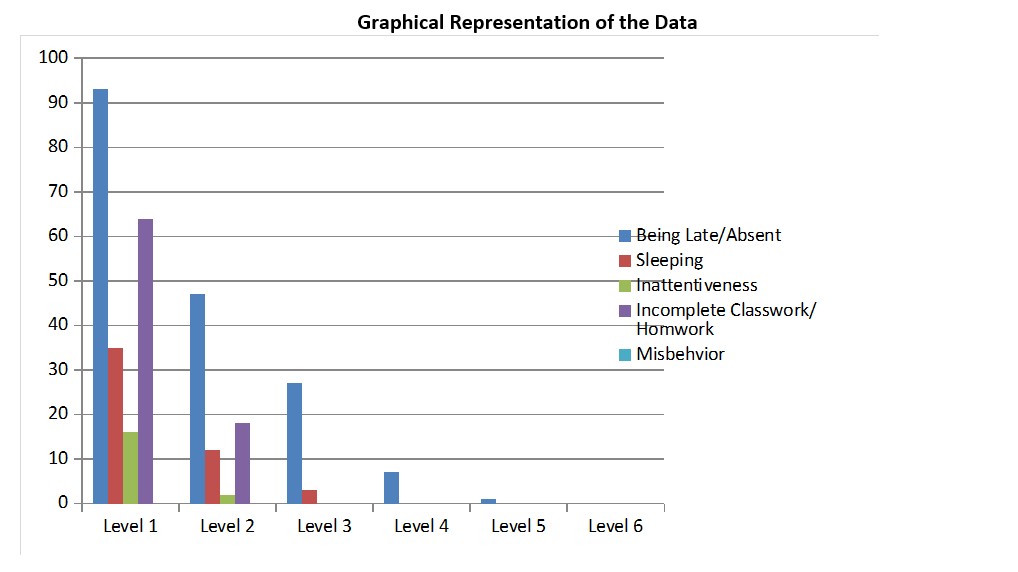
It is evident from the data that there was a steady decline in the number of cases across the different categories of lapses.
For example, the number of cases of being late/absent in Level 1 dropped from 93 to only 1 case of Level 5 whereas students who reached Level 1 in sleeping case was 35 which persisted till Level 3 with only 3 students. In the case of inattentiveness, out of 16 students in Level 1, only 2 crossed into Level 2. Regarding the regularity of students in their daily class work, 64 cases were recorded in Level 1 which decreased to merely 1 in Level 3. And finally, misbehavior by students as per my understanding was zero throughout the year.
Only in the case of ‘being late/absent’, 7 students reached Level 4 which means that their parents/guardians were contacted to report the matter and requested to guide their wards and only 1 student was reported to the principal’s office for crossing over to Level 5. In the rest of the cases, after Level 2 which involves detention, there was drastic decline with only 3 students being reported for sleeping to the headmaster’s office for crossing the Level 2 and 1 student for his/her incompletion of class work.
Should I Consider my Remedial Measure Effective Empirically?
I guess so. However, the cause of concern having experienced daily at work and backed up by the data is the alarming cases of ‘being late/absent ‘on Level 1 which numbered at 93 students out of 171 students of the classes: XII A(46 students), XIIB (43 students), XIA (39 students) and XIB ( 43 students). In this category of lapse, the decline in the case is almost by half at each level till the 4th Level. What the data suggest is that again almost half of the total number of students took undue advantage of 3 chances/warnings given in the Level 1. Most of the cases in this category are students being late after the two breaks- the short recess and the lunch break. In other categories of lapses, the breach at the Level 1 is higher compared to the subsequent levels. My intention behind giving students 3 chances/warnings is to provide them opportunities to be self-disciplined without the extrinsic remedial measures. The question is if I should be driven by data to do away with the 3 chances of intrinsic remedy. One encouraging aspect the data reveal is that students restrain from crossing 3rd Level which can be deduced as their fear or respect for their parents which deter them from being reported to them.
Finally, what I have learned from the experience of implementing this system for three years is if there is clearly defined consequences for the breach of classroom decorum students do self-regulate their behavior. Some students may misuse the remedial opportunities given to them, but knowing their backstories of broken family, dysfunctional parents, death of a parent and so on from their write ups, interactive sessions and communicating with their parents, I have realized to be sensitive to their minor lapses when their internal self is in turmoil.
I will conclude with a rough record of a rancorous response from the parent of a problematic student to my intimating him/her about the child:
“Leave my child alone. Don’t bother him. You teachers are bullying him. If he is absent in the class, it does not matter. It is his last year. He will leave the school next year. Let him live in peace. It doesn’t matter if he fails as long as he is happy. If you have any problem, you leave the school. Do you understand?”
—
* Born and brought up in Darjeeling, Tenzing Rapgyal is a PGT in English Literature at the TCV school, Dharamshala. His debut book ‘Moments: Loss, Love and Longing’, a collection of poems, won an International Excellence Award in 2023 while his second is an anthology of stories, plays and essays entitled, ‘What Do Animals Talk About?’ He also has two books waiting to be published while already working on a fifth one, a novel. He has been widely published in various educational magazines.
A version of this article was published on the teacherplus.org website in Aug 2025.