


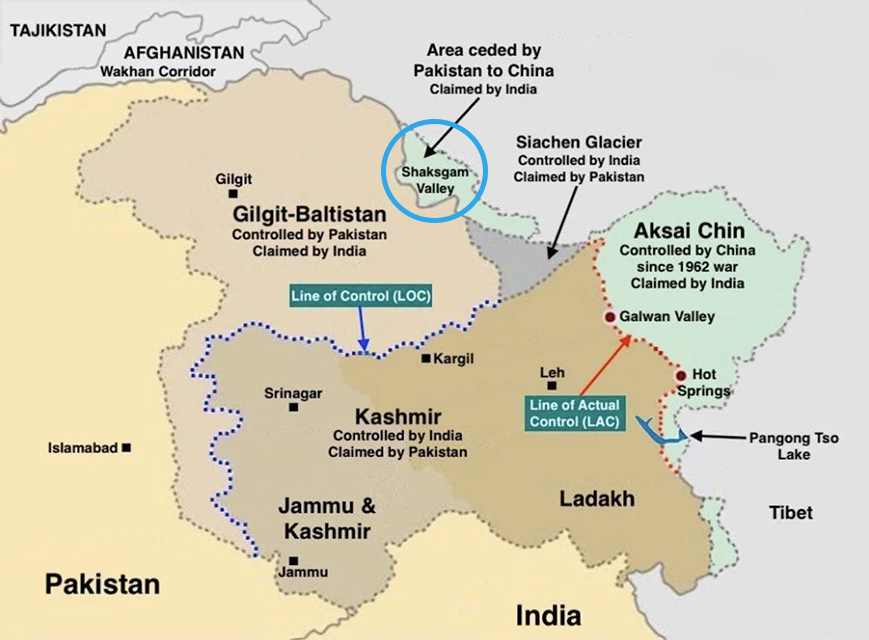
(TibetanReview.net, Jan13’26) – China has on Jan 12 defended its illegal acquisition in 1963 of the Shaksgam Valley of India’s Union territory of Ladakh, following New Delhi’s sharp criticism on Jan 9 of its expansion of the China-Pakistan Economic Corridor (CPEC) projects to this area as well as the rest of Pakistan-occupied Kashmir (PoK) the whole of which is claimed by India. China has sought to make the point that its infrastructure projects in the area are “beyond reproach”, said Indian media outlets over Jan 12-13.
India, on the other hand, stressed in its Jan 9 criticism that it reserved the right to take necessary measures to safeguard its interests as Shaksgam valley, like PoK, is its territory.
The CPEC is a key set of projects under Chinese President Xi Jinping’s signature Belt and Road Initiative (BRI) for global outreach.
“We… do not recognise the so-called CPEC, which passes through Indian territory that is under forcible and illegal occupation of Pakistan,” India’s External Affairs Ministry spokesperson Randhir Jaiswal had said in his Jan 9 criticisms.
Pakistan took control of Shaksgam Valley during the first India-Pak war of 1947-48. Located in a sensitive spot bordering East Turkestan (Xinjiang), the high-altitude Shaksgam Valley, or the Trans Karakoram Tract, lies north of the Karakoram range, close to the disputed Siachen/Aksai Chin area. It is part of the Hunza-Gilgit Region of PoK, noted an ndtv.com report Jan 13.
Pakistan illegally ceded 5,180 sq km of Indian territory in the Shaksgam Valley to China in 1963 from areas illegally occupied by it under the Sino-Pakistan Border Agreement. New Delhi has resolutely rejected this action as unlawful and illegitimate, asserting India’s rightful claim to the territory, the report added.
* * *
When asked about India’s position on Shaksgam, Chinese Foreign Ministry spokesperson Mao Ning has told a media briefing in Beijing that “first of all, the territory you mentioned is part of China’s territory.”
“China’s infrastructure activities in its own territory are beyond reproach,” she has added, responding to a question on India’s criticism.
Mao has maintained that China and Pakistan had signed a border agreement and determined the border between the two countries since the 1960s.
“These are the rights of Pakistan and China as sovereign states,” she has added.
* * *
However, accordingly to the report, the agreement did not give ultimate sovereignty over the Shaksgam Valley to China. Rather, Article 6 of the 1963 agreement clearly states: “the two Parties have agreed that after the settlement of the Kashmir dispute between Pakistan and India, the sovereign authority concerned will reopen negotiations with the Government of the People’s Republic of China on the boundary as described in Article Two of the present Agreement so as to sign a formal Boundary Treaty to replace the present agreement.”
Mao has said, “Such agreement and CPEC will not affect China’s position on the Kashmir issue, and China’s position remains unchanged in this regard.”
But despite the unsettled status of Shaksgam Valley under the 1963 agreement, China has reportedly started the construction of an all-weather road through it, ignoring New Delhi’s consistent objection to Chinese movement in the area.
Beijing’s construction activity in Shaksgam gained pace after the prolonged 2017 standoff with India in Bhutan’s Doklam area, the report noted.
Also, in 2021, the South China Morning Post reported that Pakistan was looking to build new overland border crossings with China that would potentially boost both their military interoperability against Indian forces in Ladakh and the rest of Kashmir, the report said.