


(TibetanReview.net, Sep18’26) – Climate change, including Human induced factors and industrial emissions, was a key factor in preconditioning the devastating glacier-avalanche triggered flash floods of ice, rock, mud, and water which swept through the Tibet-Nepal border on Aug 26 morning, killing or leaving missing thousands of people without any prior warning, reported Reuters and other news agencies Sep 17, citing the World Weather Attribution (WWA) group of researchers.
As of Aug 26, the flash floods have resulted in at least 1,410 deaths and 6,145 missing in Nepal, alongside 43 deaths and 519 missing in the Tibet. However, the numbers of the dead and missing in Tibet are feared to be much more than these bald officially cited figures in view of China’s denial of access to independent journalists and other witnesses and strict control on information about the disaster there.
Many blame China’s reckless mining and infrastructure devastation as well as militarisation of the Tibetan Himalayas for speeding up the global warming effect in the region.
WWA, a collaboration involving Imperial College London and climate scientists from around the world, has said industrial emissions had significantly warmed the snow-capped Himalayan region. According to the study, the disaster was not caused by a single extreme weather event, but rather a “compound crisis” shaped by long-term warming, glacier retreat, permafrost thaw and geological instability.
The researchers have said rapidly warming temperatures in the region had caused glaciers to thin and had melted ice and permafrost buried deep in the bedrock of the Himalayas, contributing to the catastrophic glacier collapse that flooded parts of Nepal and Tibet.
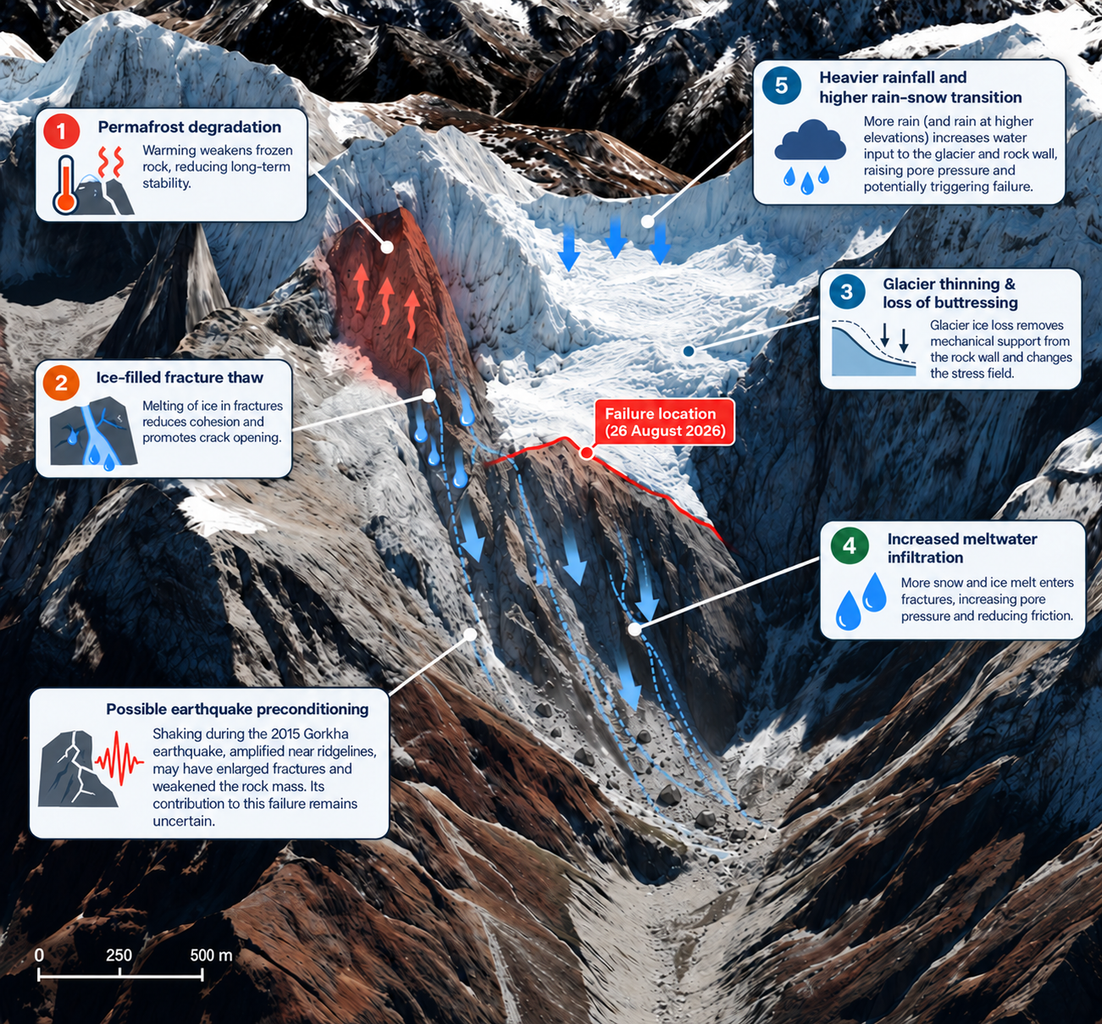
While it is difficult to ascertain the precise role played by climate change in the collapse of around 2 sq km (0.8 sq miles) of rock wall and glacier ice on the Langtang Lirung mountain last month, soaring temperatures created the preconditions that made it more likely, they have added.
“There’s absolutely no doubt that human induced climate change played a role here in the preconditioning of the disaster through permafrost thawing, through thinning of the glaciers, through having more rainfall instead of snow,” Friederike Otto, a climatologist at Imperial College London, has said.
Mean temperatures were stated to be around 5 degrees Celsius (9 degrees Fahrenheit) higher than normal in the Himalayan region in August, with 1.5 C of the increase coming from climate change.
Unusually high levels of snowfall in October and November of last year were also stated to have also added to the volume of meltwater once temperatures began to rise, which could have helped trigger the glacier collapse.
The study has found that glaciers in the region had been thinning by about half a metre per year (about 1.6 feet) since the year 2000, changing stresses on the rock. Melting permafrost is also seen as likely to have weakened the rock wall.
Something else that may have added to the deluge caused by the plunging ice and rock was the exceptionally large amount of snow that fell in the region last October and November, the researchers have said. Extra rain or melted snow can also infiltrate into the bedrock and make it more prone to collapse. But the researchers didn’t find clear evidence that human-caused climate change was increasing summer or winter precipitation in the region, noted nytimes.com Sep 16.
“We conclude that this was a geologically vulnerable slope, potentially weakened by the 2015 earthquake, but it was destabilised further by glacier and permafrost retreat and by the excessive meltwater and exceptional warmth in the final period before the collapse,” Walter Immerzeel, a mountain hydrologist from Utrecht University, has said.