


(TibetanReview.net, Oct07’26) –Nepal has brought to an end on Oct 5 its search and rescue operation for those still missing after the devastating flash floods of Aug 26 that killed at least 1,455 people as of Oct 3, switching the main focus on rehabilitating the survivors while continuing only essential search operations. Operations are also stated to be continuing in key locations, including tunnels.
Apart from the above figure of confirmed deaths, a total of 5,285 remain missing, including 636 foreigners.
On the Tibet side, China has stuck to its bald claim of just 43 deaths, with 519 people missing, including 261 foreigners.
Critics, Western agencies, and Tibetan advocacy groups have raised sharp questions over the wide discrepancy between the low number of reported casualties in Tibet compared to the devastating toll in downstream Nepal from the flash floods.
Human rights groups and media watchdogs like Reporters Without borders (RSF) have condemned the severe media blackout and systematic deletion of content across Chinese social platforms like WeChat. Eyewitness videos capturing the scale of the horror routinely vanished from the internet. Independent outlets like Tibet Radio reported confirming numbers of local deaths that far outpaced early figures released by Chinese state media. But families and exiled Tibetans remained terrified to speak out publicly due to fears of state retaliation against their relatives inside Tibet.
Critics point out that instead of allowing transparency, the Chinese government weaponized its “Clean Internet 2026” campaign to aggressively punish individuals who attempted to share the reality on the ground. Within days of the disaster, Chinese police penalized at least 10 internet users for “spreading rumours”—which in most cases simply consisted of locals posting that over 1,000 people had been swept away by the surges.
Unlike Nepal, which allowed immediate access to international journalists and humanitarian relief organizations, China strictly barred independent journalists from entering the affected areas. Critics note that authorities also tightly controlled the communications of relocated survivors in Kyirong, leaving state-run media as the only permissible source of information. This allowed Beijing to control the narrative globally by heavily prioritizing footage of successful rescue operations over reporting the factual severity of the destruction.
The disaster occurred after a glacier on Nepal’s Mount Langtang Lirung fractured at an elevation of 5,200 meters (17,060 feet), triggering an ice-rock avalanche that developed into a massive debris flow which flowed from Tibet’s Kyirong region, swept through valleys along the border into Nepal’s Rasuwa district.
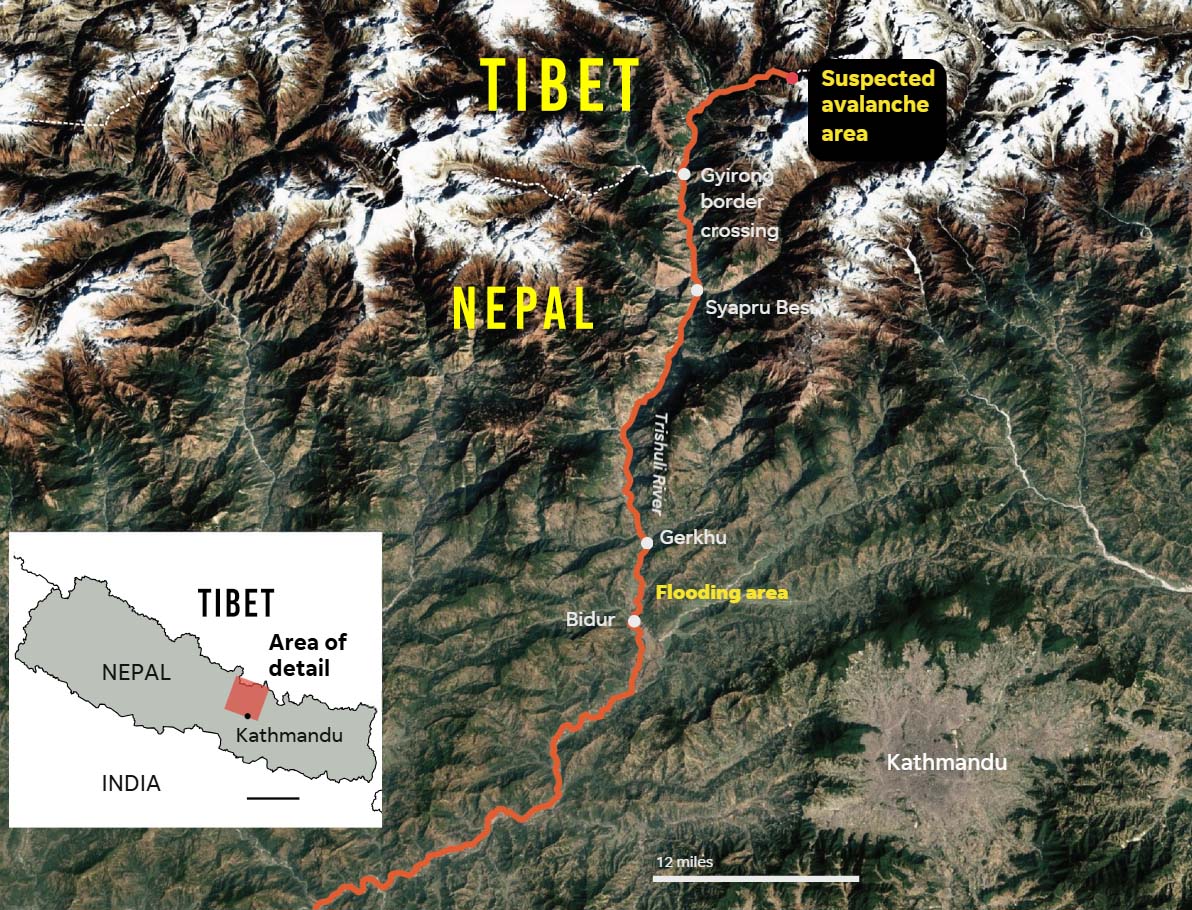
The floodwaters and mudslides buried the Gyirong border crossing in Tibet, and caused extensive destruction in Nepal’s Rasuwa, Nuwakot, Dhading and Kavre districts, as well as the Kathmandu Valley.
“We are moving from the search and rescue phase to the search and rehabilitation phase,” Reuters Oct 6 quoted Phanindra Paudel, chief of the National Emergency Operation Center, as saying.
He has said authorities were considering how to legally declare the missing people dead to allow their families or relatives to complete insurance, banking and other legal formalities.
The report cited authorities as saying Nepal needed nearly $5 billion for the early recovery and rehabilitation of the thousands of people displaced by the flood.