


(TibetanReview.net, Sep21’26) – Pakistan never had a border with China so long as Tibet was an independent country at least till 1951 and the same has been the case with India. That year, China forced Tibet to sign a so-called “17-Point Agreement on Measures for the Peaceful Liberation of Tibet” upon pain of inflicting a bloodbath on the people of the militarily defenceless neighbouring country. India followed it up with the signing of a trade agreement with China in 1954, by which it recognized Tibet as an autonomous region of China. These development brought China on the doorsteps of Pakistan and India, whether legally or illegally.
On Sep 16, India rejected “the so-called Pakistan-China Boundary Joint Commission,” asserting that there is no recognised boundary between Pakistan and China concerning Indian territory and that any such arrangement had no legal basis.
Responding to media queries, India’s Ministry of External Affairs (MEA) spokesperson Randhir Jaiswal said India’s position on the issue was “clear and consistent” and reiterated that New Delhi had never recognised the so-called China-Pakistan Boundary Agreement of 1963.
This referred to the fact that on Mar 2, 1963, a Sino-Pakistan Boundary Agreement was signed by which Pakistan ceded control of the Shaksgam Valley of Ladakh (then part of Jammu and Kashmir state of India but illegally occupied by Pakistan) to China. By that agreement, Pakistan provisionally transferred about 5,180 square kilometres of the valley to China.
However, Article 6 of the agreement stated that the boundary arrangement was temporary and subject to renegotiation after the final settlement of the Kashmir dispute between India and Pakistan.
Pakistan has described the establishment of the commission as a “significant milestone” that would deepen cooperation on border management, trade and connectivity between these two regional rivals of India.
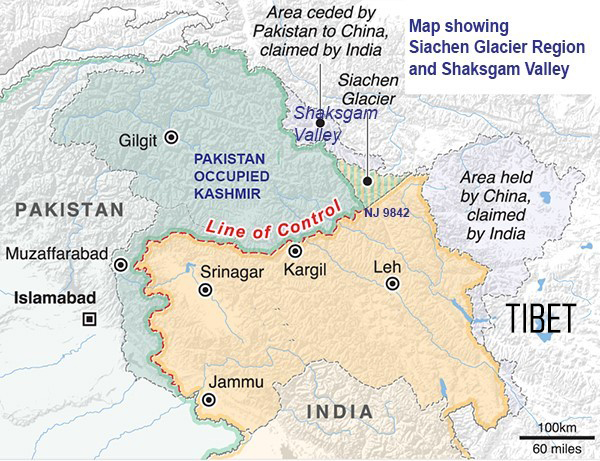
The agreement formalises the boundary between Pakistan and China in this remote part of the mountainous region, noted bbc.com Sep 21.
China has remained silent on the matter so far. However, the report cited Husain Haqqani, former Pakistani ambassador to the US and now a senior fellow at Anwar Gargash Diplomatic Academy and Hudson Institute, as saying the development served as a signal to India that Beijing continued to view Kashmir through the Pakistani prism.
“China has never accepted India’s position on Kashmir and China views Gilgit-Baltistan from the Pakistani, not Indian prism,” Haqqani has said, referring to the region in Pakistan-occupied Kashmir that borders Tibet and which India claims as part of its territory.
Jaiswal has maintained that the entire Union Territories of Jammu and Kashmir and Ladakh have always been, and will remain, integral and inalienable parts of India.
The MEA spokesperson has said India “resolutely opposes and rejects” any attempt to alter the status of the territories under occupation or legitimise what it called illegal occupation. He has said any purported boundary cooperation between China and Pakistan involving Indian territories would be “completely unacceptable” to New Delhi.
“Instead of engaging in such theatrics, we call on Pakistan to immediately vacate from areas under its illegal and forcible occupation,” Indiatoday.in Sep 16 quoted Jaiswal as saying.
* * *
The announcement came at a particularly sensitive moment. India and China are seeking to stabilise their relationship after years of military tensions along the Line of Actual Control (LAC), the disputed line separating their forces along much of their Himalayan frontier. At the same time, Beijing and Islamabad are deepening cooperation along a neighbouring stretch of the frontier that India also claims, noted the bbc.com report.
Haqqani has said Islamabad’s position had evolved in response to developments in Indian-administered Kashmir.
“Pakistan still maintains that the final status of Jammu and Kashmir is yet to be decided,” Haqqani has said. “But since India has made internal changes – for example, the abrogation of Article 370 – in its part of Kashmir, Pakistan sees no issue with simply institutionalising what has been de facto with China since 1963.”
“There aren’t any immediate or apparent implications for the LAC as of now,” he has said.
That suggests that the significance of last week’s announcement may lie less in an immediate change to the disputed Himalayan frontier than in the gradual institutionalisation of arrangements that India has consistently rejected, noted the bbc.com report.
Pakistan, he has added, remained “China’s secondary deterrent against India” – and Beijing’s engagement with Islamabad would continue to send that message to Delhi.