


(TibetanReview.net, Aug29’26) – China has reported 7 deaths and, with it, 554 missing as a result of the tsunami-like flash flood of rocks, mud, ice, and water which hit the Kyirong area of Tibet in Shigatse City before it barrelled down through the Gyirong Port to enter Nepal where the number of those officially confirmed dead has risen to 627 as of 10 am local time on Aug 29 while around 3,000 remain missing.
China has provided very little information about the nature and scale of the disaster, and its entire media coverage is focused on the search and rescue operations and the country’s top leadership’s efforts to direct guidelines for these purposes.
Videos showing the terrifying scale of flooding in Tibet began disappearing from the internet in China, raising fresh questions over what information is reaching the outside world from the disaster zone, said news18.com Aug 29.
Reports from the region have noted that videos showing the floods, including appeals for help from people affected by the disaster, have been removed from Chinese social media platforms. Some local reports and witness accounts also reportedly disappeared shortly after being published.
China’s official media coverage has largely focused on rescue teams, emergency operations and directions issued by senior leaders, while independent reporting from the affected areas remains extremely difficult, the report said.
This makes China’s official media reports on the number of the dead, and missing, as well as conditions in the affected areas within Tibet impossible to know.
The concern is that much of the information available publicly is state-controlled, while independent footage and first-hand accounts appear to be disappearing, the report said.
***
The dramatic CCTV footage of torrent of water tearing through Gyirong Port, one of the main border crossings between Nepal and Tibet, sweeping away all in its path as hundreds of people fled for their lives, has been seen across the outside the world, but not in China. Only a single still-frame shot has been broadcast so far by the country’s state-run flagship news bulletin, noted the bbc.com Aug 29.
It has also been difficult to find the video on China’s heavily censored internet. It is just as hard to even find posts describing the flash flooding that has claimed hundreds of lives, with just as many still unaccounted for since Aug 26, the report said.
The scale of the disaster and damage on the Tibetan side could be gauged from the fact that Beijing has launched a massive rescue operation involving hundreds of emergency workers, while Premier Li Qiang, in a rare occurrence, visited the site the very next day, and President Xi Jinping chaired an emergency meeting with party officials to co-ordinate these efforts.
Beijing’s sensitivities about Tibet – even the very mention of it – are especially apparent at times likes this, the report said. There have been daily updates on the missing and the dead, and Beijing has also been posting updates on the rescue operations, as well as the dangers posed by a barrier lake that has been at risk of overflowing.
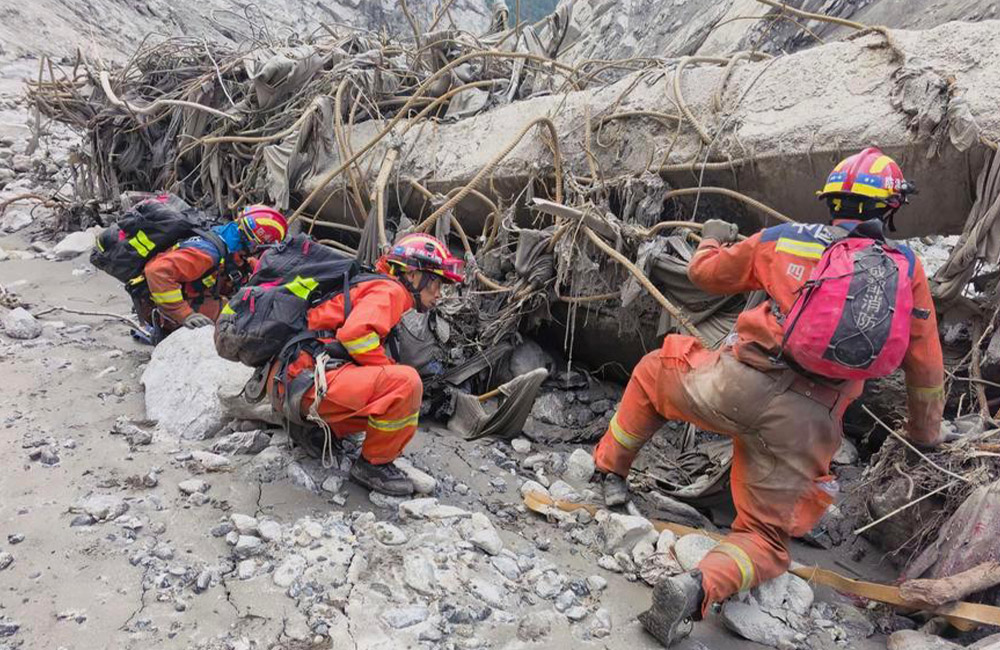
On (Aug 29), new footage from Chinese state media showed rescue teams wandering in a wasteland of mud and rock while calling out to anyone trapped. But there is little detail beyond that. There are no accounts from survivors in Tibet, and almost no user-generated footage showing the deadly moments or their aftermath.
“We are yet to hear from anxious families of those missing. Trying to contact people there is near-impossible during regular times. As a journalist who has covered North Korea, it has often been easier for me to contact interviewees in Pyongyang than it is in the Tibetan capital, Lhasa,” said bbc’s China correspondent Laura Bicker,
* * *
The reason for what the world might see as a muted response is to preserve the one thing Xi covets for his country: stability. The Communist Party will fear that such a disaster could fuel discontent, either with the response or the lack of foresight to prevent it, the report said.
China may also fear the impact of a tragedy like this and its potential to be a rallying factor, especially in a community where faith has long played a central role, the report noted.
Just hours after the disaster struck, the Communist Party machine tried to rally its grassroots to stem any signs of discontent over its handling of the landslide.
A notice issued by the local party office was stated to urge members to step up and help in disaster relief efforts in their area and provide emotional guidance or psychological support to affected residents. And the key line instructed them to “make every effort to maintain social order and ensure stability and public confidence in the disaster areas”. Those who perform well would be rewarded – and those who do badly “would be held accountable”.
Tibetans in the region can be detained or arrested for speaking to journalists or posting anything online that is seen as contrary to the government narrative, according to rights activists. That is making it difficult for Tibetans outside the region to find out what has happened to their relatives, the report said.
And so, as the true scale of the devastation caused by the flash floods in Nepal and Tibet is still unfolding, the picture is emerging far more quickly in Nepal than in Tibet, where strict controls on the flow of information from one of its most sensitive regions are hampering the public’s understanding of events, noted theguardian,com Aug 28.
While the full death toll will not be known for days as the worst-hit areas are hard to reach, in the case of Tibet, given the history of China’s draconian control over information, the true figure may never be known, noted theconversation.com Aug 28.
The region is administered as a militarised frontier. Access runs on permits and clearances, the area is closely watched by armed police and the military and outsiders – foreign journalists, independent researchers, at times even diplomats – are routinely kept out. Tibet is an information black hole, the report noted.