


(TibetanReview.net, Mar12’26) – In a dramatic reversal of decade-long political dominance, the Rastriya Janamorcha has lost in its traditional stronghold of Baglung, a hill district in Gandaki Province, in the Mar 5 poll in Nepal’s general election, reported the kathmandupost.com Mar 10. The solidly Nepali-speaking district is the bastion of this leftist party. The party’s chairman, Chitra Bahadur KC, has blamed foreign influence, by which he meant not China, but the USA, supposedly acting through the Dalai Lama, for his party’s humiliating loss.
Despite having an electoral alliance with the Nepali Communist Party, one of the two main communist parties of Nepal, its candidate, Krishna Prasad Sharma Adhikari, failed to garner enough votes to even retain the security deposit (Rs10,000).
Sushil Khadka of the RSP, which has swept the polls across Nepal with a massive mandate, won the Baglung seat with 20,927 votes, as against Adhikari’s 4,521, a distant fourth. KC himself stood as a proportional representation candidate. But since the party is unlikely secure at least three percent of the nationwide votes needed to get proportional representation, KC’s parliamentary prospect is all but nil.
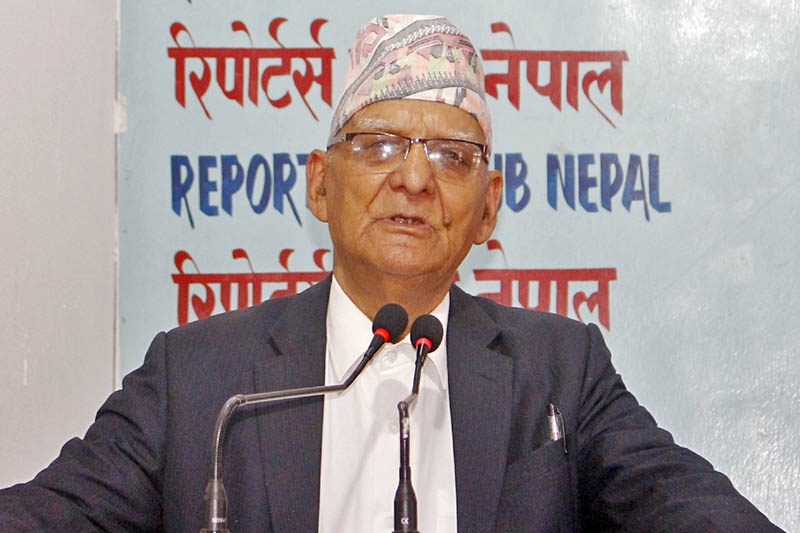
Rastriya Janamorcha.
The report cited voters in Baglung as saying the left candidates’ defeat in the Baglung election signalled the end of an era as younger voters looked for new faces and different ideas.
But KC would not have it and has blamed the results partly on what he has called growing foreign influence. The report cited him as alleging that youth trained through non-governmental organisations and international NGOs had shaped public opinion during the campaign.
When such forces influence institutions, media and experts, the outcome cannot be different, KC has alleged, saying that the broader national environment had turned unfavourable for his party. He has admitted that Baglung alone could not resist a nationwide political shift.
Still, he has maintained, “There is an attempt to turn Nepal into a [foreign] military base to pit China and the United States against each other through the [exiled Tibetan spiritual leader] Dalai Lama,” the report quoted KC as claiming.
“When the political environment across the country, from east to west, has been shaped according to American interests, it was unrealistic to expect that we alone could win in Baglung.”
KC is a former deputy prime minister and minister of poverty alleviation of Nepal.
With its capital in the tourist city of Pokhara, Gandaki Province is home to districts such as Manang, Mustang and Lamjung along Nepal’s northern belt where Tibetan Buddhism is widely practised. However, Baglung is a predominantly Nepali-speaking district with a rich mix of cultures, including Magar, Chhetri, Brahmin (Bahun), Newar, Gurung, Chhantyal, and Thakali, with significant Dalit communities.
Of the total of 275 constituency (direct vote) and proportional representation seats, the RSP of the 35-year-old Balen(dra) Shah, former Mayor of Kathmandu, has won 162, following by Nepali Congress with 38, CPN (of former Prime Minister KPS Oli) with 25, Nepali Communist Party (of former Prime Minister Prachanda) with 17, Shram Sanskriti Party with 7, and Rastriya Prajatantra Party with 5.