


Reporting on a session of a conference devoted to the science and practice of end-of-life care under the auspices of the state-level Minnesota Network of Hospice & Palliative Care, Palden Tsering* writes that while in Western medicine, a “good death” is often defined in terms of pain control, symptom management, and patient autonomy, the Tibetan perspective expands that definition to answer the question: what does it mean to prepare for death, offering a coherent framework that places suffering, meaning, and awareness at the center of the human experience.
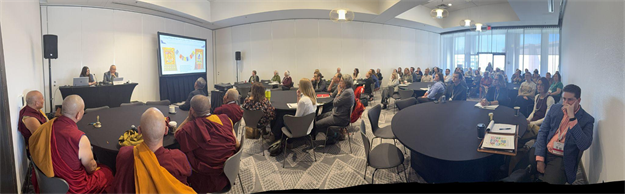
At a conference devoted to the science and practice of end-of-life care, one session stood apart—not for new technology or clinical protocols, but for something far older: a philosophical and spiritual framework that views death not as an endpoint, but as a transition.
At the Minnesota Network of Hospice and Palliative Care (MNHPC) Cultivating Connections: A Spring Symposium 2026, held April 19–21 at the Radisson Blu Mall of America, a breakout session on Tibetan Buddhist perspectives on dying drew one of the largest audiences among concurrent sessions.
Titled “Two Meaningful Lives: One Good Death, One Not-So-Good Death,” the session was presented by Dr. Tsewang Ngodup, MD, MPH, and Jess Bruxvoort, RN, BSN, PHN, who introduced attendees to a model of end-of-life care rooted not only in symptom management, but in spiritual preparation, mental clarity, and cultural context. The session drew more than 50 physicians, nurses, and healthcare professionals, making it the most attended breakout session of the symposium. Rinpo Yak, a board member of the Tibetan American Foundation of Minnesota (TAFM), also attended and provided support for the session.
What unfolded was less a lecture than a reframing of one of medicine’s most difficult questions: what does it mean to die well?
A Clinical Space Transformed
The session began not with slides, but with prayer.
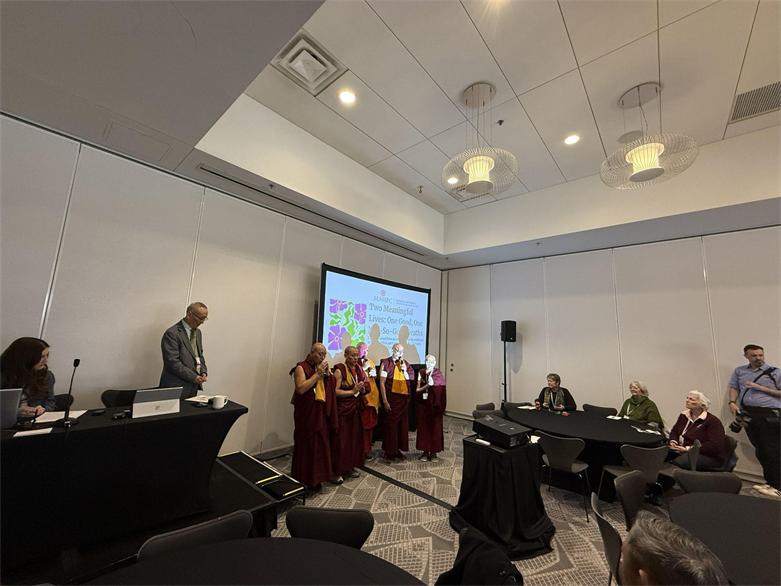
Prominent spiritual teachers from Minnesota’s Tibetan Buddhist community opened and later closed the presentation with traditional prayers, briefly transforming a clinical conference room into a contemplative space. Those offering prayers included H.E. Apong Rinpoche of the Joyous Path Buddhist Meditation Center; Reverend Norbu Dadul and Yeshi Topgyal of the Gyuto Wheel of Dharma Monastery; Venerable Geshe Ngawang Tenpa of the Sera Jey Buddhist Cultural Center; and Reverend Ani Ngawang Choekyi, representing the Minnesota Tibetan Buddhist nuns.
Their presence grounded the discussion in lived tradition, signaling from the outset that the session would move beyond conventional clinical frameworks.
Two Lives, Two Endings
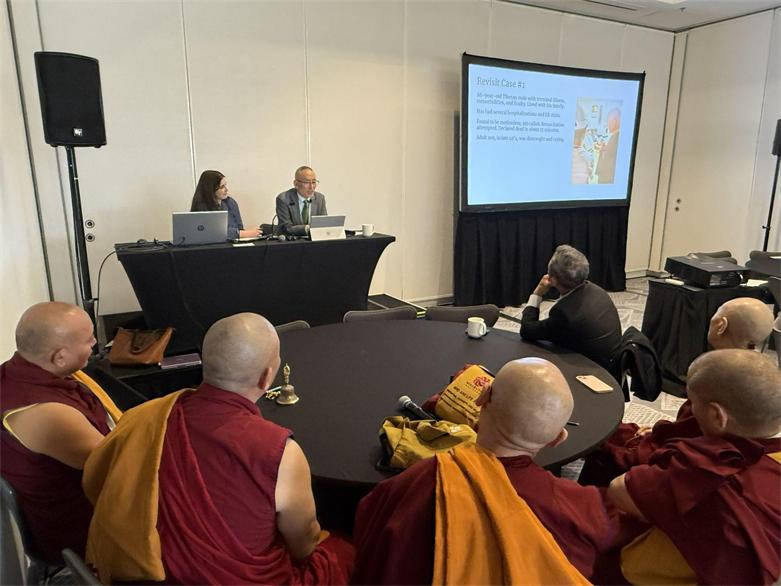
At the center of the presentation were two end-of-life cases, carefully chosen to illustrate contrasting experiences of dying.
One case involved a 102-year-old Tibetan Buddhist monk, who, despite multiple chronic conditions, died peacefully in hospice care. Surrounded by members of his spiritual community, prayers were recited continuously at his bedside. The presenters described this as an example of a “good death”—not because suffering was absent, but because the patient’s final moments were marked by calm, familiarity, and spiritual continuity.
The second case presented a more medically driven and fragmented dying process, raising difficult questions about the limits of clinical intervention and the absence of spiritual context.
Together, the cases invited the audience to reconsider a fundamental assumption: that a good death is primarily a medical outcome.
Death as Process, Not Moment
A key concept introduced during the session was the Tibetan Buddhist understanding of Bardo, often translated as the “intermediate state.”
Rather than defining death as a single moment—such as cardiac or neurological cessation—the Bardo framework describes a series of transitions, including the dying process, the moment of clear light, and the period leading toward rebirth. In this view, consciousness does not necessarily end when clinical life signs cease.
This perspective carries practical implications for care. For example, presenters emphasized the importance of minimizing disturbance immediately after death, based on the belief that awareness may persist beyond the moment recognized by modern medicine.
For many in the audience, this idea stood in sharp contrast to standard hospital protocols, where post-mortem procedures often begin quickly.
Philosophy Meets Practice
The session introduced several core Buddhist concepts that underpin this approach to death and dying, including:
- The Four Noble Truths, beginning with the recognition that suffering is inherent in life
- Impermanence, the inevitability of change
- Karma, the moral continuity shaping experience
- Non-self, the absence of a fixed identity
- Interdependence, the relational nature of existence
These ideas are not abstract, the presenters argued, but directly relevant to how patients experience dying—and how caregivers respond.
Preparation for death, in this framework, is not something that begins in the final days of life. It is cultivated over decades, through reflection, ethical living, and mental training.
Guidelines for Care
Beyond philosophy, the session offered practical guidance for healthcare professionals working with Tibetan Buddhist patients and families.
Recommendations included:
- Practicing cultural humility and sensitivity
- Engaging qualified interpreters when needed
- Encouraging early conversations about end-of-life preferences
- Allowing space for prayers, chanting, and ritual practices
- Maintaining a calm, quiet environment during the dying process
- Avoiding unnecessary physical disturbance after death
The presenters stressed that these practices are not merely symbolic, but central to how patients and families understand dignity, continuity, and meaning at the end of life.
A Different Definition of “Good Death”
In Western medicine, a “good death” is often defined in terms of pain control, symptom management, and patient autonomy.
The Tibetan perspective expands that definition to include:
- Mental clarity at the time of death
- Emotional and relational closure
- Spiritual readiness
- Community presence and support
Under this view, death is not something to be managed, but something to be navigated.
A Lasting Impact
As the session concluded with a dedication prayer, the presenters marked the occasion with a gesture of cultural significance. Dr. Tsewang Ngodup presented a khata—a traditional Tibetan ceremonial silk scarf—to Kristina Wright-Peterson, Executive Director of MNHPC, in recognition of her support for the Tibetan community and for making the session possible. In Tibetan culture, the offering of a khata symbolizes respect, gratitude, and auspicious connection, and its presentation underscored the spirit of mutual recognition that had defined the session.
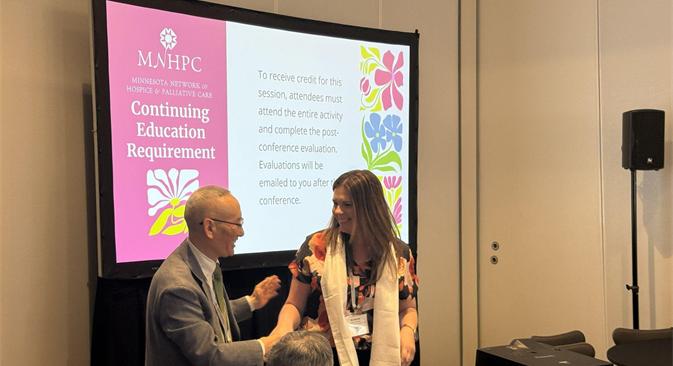
Following the closing, many attendees remained in the room, approaching both presenters and spiritual leaders to express gratitude and continue the conversation.
Several participants described the session as “deeply moving” and “professionally transformative,” noting that it challenged assumptions about the role of medicine at the end of life.
Beyond Medicine
In a healthcare system increasingly focused on extending life, the session raised a quieter but equally urgent question:
What does it mean to prepare for death?
The Tibetan Buddhist tradition does not offer simple answers. But it does offer a coherent framework—one that places suffering, meaning, and awareness at the center of the human experience.
For a room full of clinicians accustomed to treating the body, it was a reminder that the process of dying may require something more.
—
* Palden Tsering is a practicing Buddhist who resides in the Twin Cities.
** the speaker, Dr. Tsewang Ngodup, informed the audience that the gathering served as a tribute of gratitude in connection with this year being celebrated as the Year of Compassion in honor of the 90th birthday of His Holiness the 14th Dalai Lama.